



Thanks to AI, your product team is releasing new features faster than ever. While the pace of innovation is exciting, it brings with it a new challenge: getting customers to use, adopt, and realize value from all these new capabilities. You may have an established customer education strategy and team, but are you ready to keep pace with the firehose of product enhancements?
We asked customer education leaders at two rapidly growing software companies with AI-driven products how they keep up with product innovation. They shared two approaches to increasing product adoption that are rooted in learning practice, certification and targeted intervention, as well as a way to track AI product adoption separately.
How Does Certification Increase Product Adoption?
Gong, the leader in Revenue AI with over $500 million in annual recurring revenue, uses a time-honored learning practice to power adoption of their future-forward product: certification. Their customer-facing and partner certifications include proctored exams, integrated badging, and shareable credentials.
Tim Halter, Instructional Design Manager at Gong, shared in a recent webinar how certification increases product usage.
In particular, Gong’s Program Manager certification has driven an uptick of 46% in team-wide activity, which means certification pathways for the admin role boosts usage across the customer account.
Chief Customer Officer Simon Frey posted on LinkedIn that Gong customers with certified Program Managers have 21% higher adoption compared to those without.
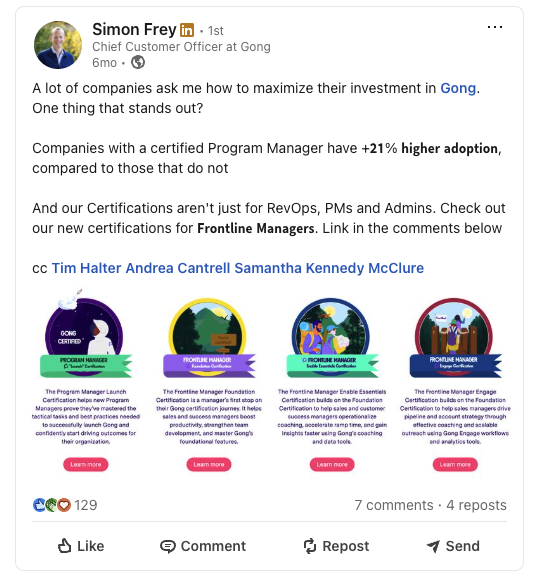
While certification might be the gold-standard for influencing adoption, badges awarded for shorter learning milestones can motivate users to complete more training. Gong uses an integration with Accredible to allow users to share their certification status on LinkedIn, giving customers something to brag about while spotlighting the Gong brand. Gong also awards badges for early milestones to build momentum for further learning deeper product adoption.
“We have badges just for getting through the ‘Getting Started’” portion of training, Halter explains, “and we use the nurture campaigns in Thought Industries to follow up with an email that says, ‘Hey, congratulations, you completed this, you’re not done, but here’s your badge. Continue your learning, come back soon.”
When are Targeted Learning Interventions Needed?
Ironclad, an AI contracting company that recently surpassed $200 million in annual recurring revenue, developed an Adoption Accelerator Program to ensure customers realize value from their software purchase.
Bill Keller, Senior Manager, Learning Experience Design & Documentation for Ironclad, shared with Thought Industries how his team delivers targeted learning interventions to encourage use of key features. By closely tracking product adoption milestones across the customer journey, Kelleher’s team can identify customer accounts with lagging usage in key areas, and offer a series of training sessions to help them meet those thresholds.
“Let’s say for example we know that having really clean data is going to make a real difference in a customer’s ability to derive value from Ironclad, but there’s a good subset of customers who haven’t touched their data manager,” Keller says. “We go in and identify those customers, and we can offer them a series of three or four sessions, as well as pre-work and homework, and Q&A with Ironclad experts, and really go through it in depth.”
Ironclad then tracks the attendance in each Accelerator program, and measures that against the product adoption and the annual recurring revenue (ARR) from those customers.
“The numbers that we’ve seen are pretty impressive,” says Kelleher. “As a training organization, it’s great for us to be able to put that into perspective for our stakeholders, because it’s always so hard to really show a correlation between users taking training and what the influence is on the bottom line.”
From 91 participants in a single accelerator program, Ironclad influenced $1.2M in ARR.
Sixty-three percent of participants attended two or more sessions, which led to a 200% increase in customers using the platform.
Looking specifically at data managers, Ironclad saw a 58% increase in meaningful feature usage, such as utilizing workflows with presets.
Gong also intervenes proactively to boost adoption, although with a different approach. Rather than going directly to end-users, Gong’s Education Services team provides data to the customer success managers responsible for securing renewals for the account.
Mark Banuelos, Senior Manager, Education Services at Gong, worked with colleagues in Operations to add education consumption to a dashboard shared with Customer Success.
“Before even six months, ideally a year before [renewal decision], let’s start having the CSMs actively go into a Tableau dashboard, and they can see the education consumption,” Banuelos told his Operations colleagues. “I don’t care if it’s in Academy, I don’t care if it’s done through live training, but have they consumed anything?”
Data on consumption of learning content is then paired with adoption data to identify accounts in need of intervention.
“If they have low adoption in the platform, and or they have low education consumption, then we immediately have an automated event happen,” Banuelos explains. “It’s an alert [directed to the CSM] saying, ‘Hey, you need to engage with that customer because, maybe they haven’t consumed anything, or they haven’t had any training.”
This early warning system gives the CSM the next six months to prepare for the renewal conversation, during which they can nudge users to engage with the learning that will increase product adoption.
When the renewal rolls around, Banuelos says,
“You look like a hero as a CSM, because now you can say, ‘Hey, we went from a year ago to X number, now you have more adoption, you’re seeing your outcomes, you rolled out a new sales methodology and it’s working.’”
Giving Gong’s customer-facing teams visibility into learning data creates a holistic picture of customer health and engagement, allowing them to target interventions for accounts with lagging usage. The key is to deliver the learning interventions proactively, well in advance of the renewal date.
“We want to make sure we’re operationalizing it and getting ahead of it, and not just cramming training in as a last-ditch, hey, they renew in two months,” says Banuelos.
Why Should AI Feature Adoption Be Tracked Separately?
If new AI capabilities are a strategic focus for your business, then adoption of those features warrants closer tracking. Bill Kelleher’s team at Ironclad uses a scorecard to monitor product adoption metrics, and they measure adoption of AI capabilities and new features separately. (In February, Ironclad announced that their AI legal assistant delivered nearly six times year-over-year ARR growth, so clearly that focus is paying off.)
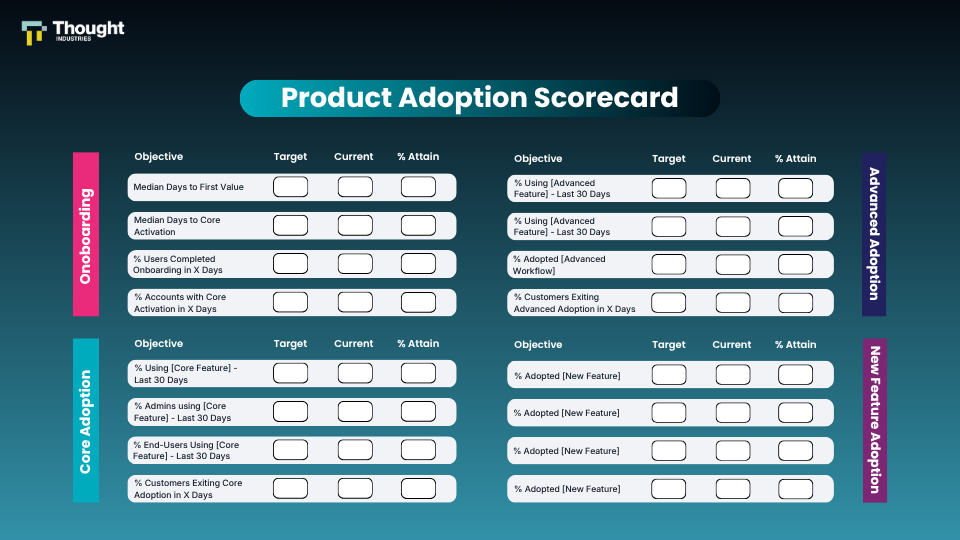
Tracking AI adoption separately helps the teams responsible for customer outcomes–product, customer success, and professional services–align on goals and identify areas for improvement. When you break product adoption metrics into smaller milestones, it’s easier to assess how effectively learning leads to behavior change. Then you can better align learning strategy to customer outcomes, and communicate more confidently to stakeholders and executive leadership.
Influence Behavior Change at Scale
Build the learning strategy that drives real behavior change, and customers will adopt and see value from your new product capabilities. Companies with AI products like Gong and Ironclad use certification, targeted interventions to influence product adoption, and monitor usage of new features separately to ensure customer education meets the needs of the business.
As Banuelos says,
“You can build this amazing platform, and you can get everybody into it, but if you don’t have a very great strategy for education, how are your [customers] going to be using what they just purchased day in and day out?”
Download our Product Adoption Scorecard to start tracking customer adoption of new AI capabilities.
If new AI capabilities are a strategic focus for your business, then adoption of those features warrants closer tracking. While your overall objection is adoption, there are different ways to measure it. Consider the percentage of end-users using the feature within the last 30 days, or the percentage of customer accounts with usage. By monitoring AI feature adoption separately, you can more easier identify where learning can be delivered as a targeted intervention to boost adoption.
Product adoption metrics show whether customer training influencing meaningful behavior change. Depending on the product, metrics might include percentage of users engaging with a specific feature, percentage of accounts with activity, by day, month, week, or quarter. The customer journey should inform the metrics used, as the ultimate goal is for customers to see value from the product and achieve their desired outcome.
Certification and targeted interventions are two approaches proven to increase product adoption.
A product adoption accelerator program is a systematic approach to increasing customer use and adoption of the product they purchased. It involves monitoring product usage against established targets, identifying low usage, and delivering targeted interventions, often in the form of additional training, to the identified users.
A product adoption accelerator program is a systematic approach to increasing customer use and adoption of the product they purchased. It involves monitoring product usage against established targets, identifying low usage, and delivering targeted interventions, often in the form of additional training, to the identified users.