



A strong customer education program is grounded in clear business objectives, such as product adoption, and we love watching how some of our customers use our platform to put this into action.
In a recent Thought Industries webinar, Adoption Accelerator: How Ironclad Guides Customer Outcomes with Prescriptive Learning, we sat down with Bill Kelleher, Senior Manager of Learning Experience Design & Documentation at Ironclad, to discuss how his team responds to one clear customer demand: “Just tell us what to do!”
From Teaching Users How, to Understanding their Why
Ironclad is an AI-powered contract lifecycle management (CLM) platform that automates, manages, and analyzes business contracts from creation to signature and renewal. Today, customer education at Ironclad has a four-tiered approach to meet the learning needs of the widest range of users:
- Free public resources can be accessed immediately.
- A trial experience supports users with initial conversion.
- Core content such as learning paths give users a deeper education on the product
- More advanced programs focus on strategic adoption of key features and capabilities.
Bill shared how the initial role of customer education at Ironclad was a customer success and support initiative, largely reactive and based on product features. “We didn’t have a feature that was undocumented, or a set of functionalities without resources. But it wasn’t focused on ‘Hey, let’s drive this type of usage,” said Bill. “Today, my team is a lot more focused on more strategic education that drives adoption, that allows us to be proactive in what we’re creating for customers and which anticipates their needs.”
By mapping users and milestones across the customer journey, Bill’s team are able to follow a customer from the implementation stage through to foundational and then advanced adoption, tracking the specific actions they need to complete to move on. For example, once customers have published a workflow configuration, created three groups and added ten users, they are considered to have foundational adoption of the product. At that point, they enter the advanced adoption stage, with new milestones unlocked, such as use of integrations and a total number of contracts completed and imported.
“If a customer has completed these specific things, they are effectively adopting our product,” Bill explained. “These signals show us that a user is probably going to renew because they are getting value from us.”
Bill can then roll that information out to stakeholders and executive leadership and break product adoption into subcategories such as AI adoption or strategic feature adoption. This provides a clear picture of what customers are doing within the product, and identifies where targeted interventions might influence the usage and adoption that will address the customer’s next set of problems.
Why Segmentation Makes Learning Meaningful
Bill recognizes that the world is moving faster than ever, and that users don’t have time to dig through hundreds of course pages to find what they need. Effective segmentation has therefore become a crucial part of Ironclad’s customer education. Ironclad segments learning by access levels, customer journey stage, how long a specific user has been using the product, user role within the company, and the success plan associated with their subscription.
This strategy requires thinking deeply about the needs of each segment. Looking back on the adoption cohorts mentioned above for example, a user in the implementation stage needs content focused on setting up an instance and seeing value quickly. This stage isn’t about optimizing for long-term health; it’s just about getting started.
As customers move to the next stage of adoption, education focuses on expanding use cases and moving towards maturity.
Finally, during what Ironclad calls the instance maintenance phase, the team is creating content for mature customers who want to delve deeper into optimizations and niche use cases, so resources need to speak to their expertise.
Bill was candid about how this segmentation can be a work in progress. “Six months ago I would say 90% of our content was in that instance configuration segment. Today, it’s more like 70/30 in favor of that foundational content, which is so important, but we’re really making inroads in building content that meets the needs of users further along the journey.”
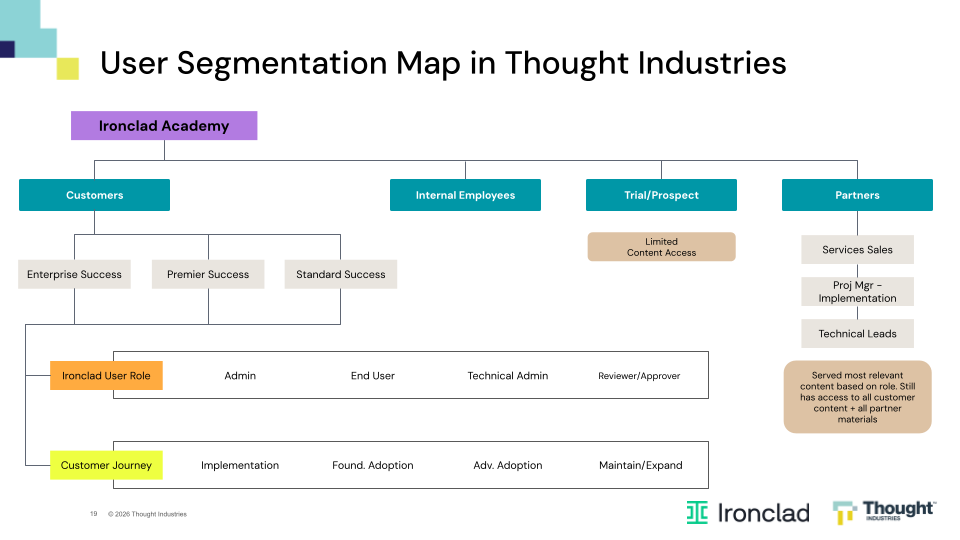
The infrastructure powering this segmentation is Panorama, the Thought Industries multi-tenancy solution that allows Ironclad to be intentional about the experience for any user. “The provisioning of these Panoramas for that multi-tenancy has been huge for us,” said Bill. There is one Academy Panorama for trials and prospects, one for customers, another for partners, and a fourth for employees. A lot of content is reused across Panoramas, but each has its own login and UX. Content is then segmented again by role through recommendation assessments and learning paths designed specifically for certain users, such as the admin onboarding path which provides a targeted introduction to the product through the administrator lens.
Ironclad also uses role-based Collections to segment learning by sending users to a landing page that outlines relevant content for their needs. Within these collections Ironclad can offer additional functionality that encourages engagement, including:
- Native Thought Industries badges that signal to the industry that users have completed a collection and have certain expertise
- Ribbons and tags that highlight novel or relevant training to the right audiences
- Filters that quickly surface exactly the resources they need.
Using the Product Accelerator Program
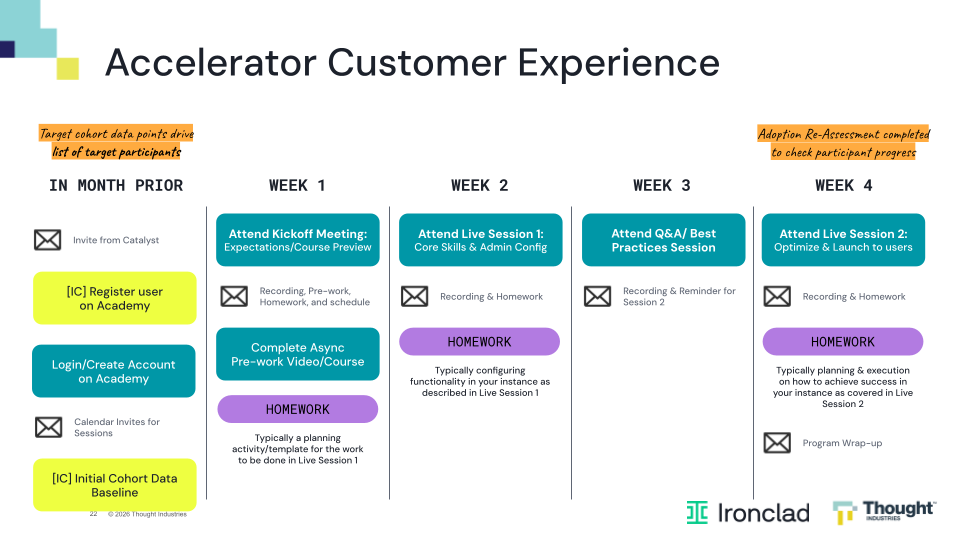
By closely tracking product adoption milestones across the customer journey, Ironclad can identify those with lagging usage in key areas, and target them with a series of training sessions that gives them a more white glove experience to help them meet those thresholds.
“Let’s say for example we know that having really clean data is going to make a real difference in a customer’s ability to drive value from Ironclad, but there’s a good subset of customers who haven’t touched their data manager,” said Bill. “We go in and identify those customers, and we can offer them a series of three or four sessions, as well as pre-work and homework, and Q&A with Ironclad experts, and really go through it in depth.”
Ironclad then tracks the attendance in each Accelerator program, and measures that against the product adoption and the Annual Recurring Revenue (ARR) from those customers.
“The numbers that we’ve seen are pretty impressive,” said Bill. “As a training organization, it’s great for us to be able to put that into perspective for our stakeholders, because it’s always so hard to really show a correlation between users taking training and what the influence is on the bottom line.”
From 91 participants in a single accelerator program, Ironclad influenced $1.2M in ARR. 63% of participants attended two or more sessions, which led to a 200% increase in customers using the platform. Looking specifically at data managers, Ironclad saw a 35% increase in the number of edits they made during a 30 day period, and a 58% increase in meaningful feature usage such as utilizing workflows with presets.
“We have really put a focus on how we can empower users through our training and our resources to get strategic adoption of the features that are going to move the needle for their organization and ours,” said Bill.“ These are examples where we’re investing a bit more time, but the results are really tangible and really easy to communicate back to the business.”
Learn More From Ironclad’s Success
This webinar was overflowing with value, and we’ve only just scratched the surface. Watch the full event to hear insights on:
- Which features to push: See Bill’s ideal order of first use sequence, which helps the team understand which features to train on, how to package live training, and where to segment for the best outcomes.
- Un-gated learning: Hear how expanding learning to prospective customers during the trial process has made a huge impact on Ironclad’s success.
- Where AI fits into the picture: Bill shares how AI can take him from 0 to 50% of what’s needed for content production before handing off to an instructional designer.