


What defines high-impact customer success and learning
We know – and so do you – that education is a huge driver of customer retention and product adoption. But, more often than not, scaling the education function in a business is easier said than done. We turned to the leaders of innovative customer education programs for insight into the mindsets that make them successful. They shared the vision, intentional design, focus on outcomes, and the alignment to business objectives that have empowered them to create high-performing customer learning.
At Thought Industries, we are constantly working to support our customers by learning from leaders of innovative customer education programs: What allowed them to produce exceptional results? How did they get there? And, how did they approach their journey differently? Asking these questions led us to build our maturity model for customer learning.
If you’re curious to get a sense of how your own program compares to industry leaders, try our customer learning maturity model self-assessment tool.
We see many barriers standing in the way of realizing the potential of customer education programs, spanning industries and company size – among them:
- Difficulty getting the level of support needed from busy subject matter experts.
- Difficulty demonstrating the business value of their program.
- Difficulty keeping learning up to date.
- Difficulty sourcing and analyzing needed data.
But, by putting exceptional customer education programs under the spotlight, we were able to uncover how they broke through these obstacles. And, even more notably, these teams realized measurable gains at every step of the customer lifecycle:
KPIs Impacted by High-Performance Customer Education:
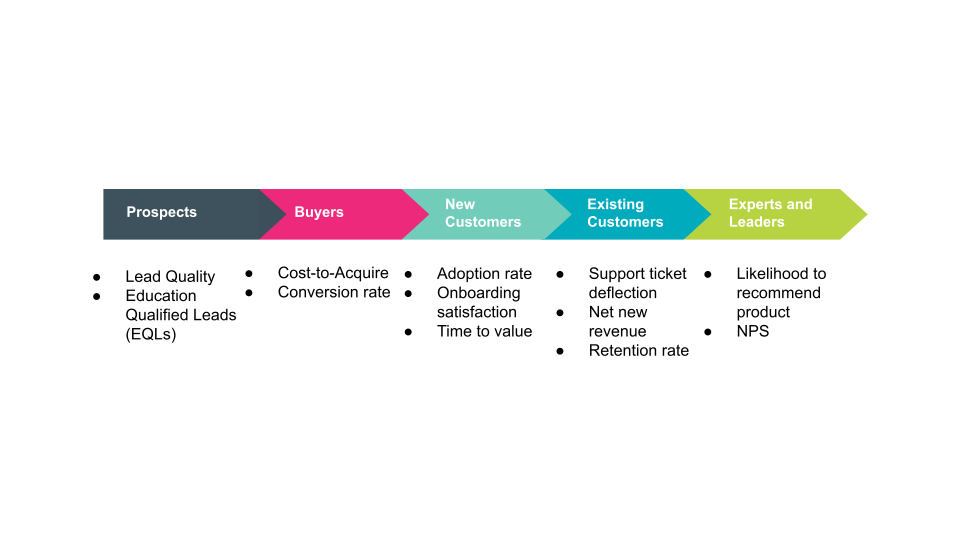
The leaders of these successful organizations tend to think differently about how to run a customer education program, and how to demonstrate clear impact on KPIs throughout the customer journey. This paradigm shift was what drove a unique ability to transcend this “stuck” feeling that so many can feel in the customer education space, and build thriving, highly mature learning organizations.
Ultimately, we’ve defined four key mindsets that highly successful learning leaders keep in their back pocket as they approach daily operations in customer education.
4 Mindsets to Level Up Your Customer Education
1. Visualize long-term goals:
While many newly-commissioned customer learning programs start with live (or virtual) training, then plan as they go, great leaders visualize the full journey to maturity, even from the first days forward. Plan to segment your learners into several groups once your library is built out next year? Keep those segments in mind when you implement a content management structure. Aim to connect education metrics with customer retention and satisfaction? Pick a learning technology that makes measurement and reporting simple. Your ultimate goals for your customer education program – even if you’re thinking years into the future – should help shape the decisions you make in the near term. While using customer education to boost demand generation may not be on your radar in the next few months, making decisions around content access and relevance to a prospect audience now (rather than later) will make this an easier transition when your team is ready.
2. Design with purpose – and then, repurpose:
For successful learning leaders, launching an educational experience is a core organizational capacity that goes beyond building exceptional training. Once a learning program is created intentionally to address specific audience segments and personas, innovative teams will find ways to reuse and repurpose content, courses, and workshops to do double (or triple) duty. We’ve seen leaders take education programs and use critical pieces of the curriculum to onboard internal employees, enhance the sales process, or improve customer support conversations and resolutions. Creating learning is never the end of the line, but rather just the beginning, when it comes to adding significant value to other teams. For effective leaders, success is not just centered on the learning team’s goals and results, but on the achievement of many teams and larger organizational metrics. When the sales team has the tools and resources they need to have impactful, successful conversations with prospective customers, the entire organization benefits.
3. Focus on customer outcomes:
High-impact customer education leaders build their programs around customer outcomes, not just content delivery. They start by asking a key question: “What does success look like for the customer?” This could be anything from achieving faster implementation, driving accuracy in their day-to-day work, or realizing specific ROI for their business so that they can meet their own personal and professional goals. Once this question is answered, strong education teams design learning experiences that lead directly to those results. Every course, certification, and resource is mapped to helping customers achieve meaningful progress with the product. This outcome-first approach builds trust, strengthens customer relationships, and ensures education feels indispensable rather than optional. By tying learning to real-world success, these leaders help customers thrive, and in turn, fuel their own company’s growth.
4. Align education with business objectives:
Successful customer education leaders approach their work with a mindset of strategic alignment. They don’t view education as a standalone function, but instead as a key driver of business outcomes like customer renewals, expansion, and loyalty. They look at the goals of the business, and create education to move that specific needle. By understanding how learning influences customer behavior and success, they design programs that directly support measurable objectives. This means connecting educational initiatives to metrics that matter to the C-suite, whether that’s deepening product adoption, reducing time-to-value, or improving retention, and continuously refining their approach based on intelligent measurements and the right data. In doing so, they elevate customer education from a support activity to a growth engine for the business.
By embracing these mindsets, customer education leaders can create impactful programs that not only foster learning but also drive measurable business growth.
To learn more about the tactics we see successful learning leaders deploy to move the needle on their customer lifecycle metrics, try our customer learning maturity model self-assessment tool.