



In our 2026 State of Customer Learning and AI report, balancing short-form content with structured learning paths was the most frequently cited priority for improving the learning experience. 37% of respondents named it one of their top three priorities.
This article is a practical how-to guide for making modular learning content, using atomic design principles, and expert advice from Emily Masterson and Eric Regnell from the Institute of Management Accountants (IMA), an organization that hosts more than five hundred courses across proprietary, third party, xAPI and SCORM content within Thought Industries. Here are our best practices.
“By building in atomic units, we can ship sooner. We can deliver a nano-course first immediately, then expand to a one- or two-unit course in two weeks, then maybe build that into a learning pathway within the month. By thinking modularly, we can ship fast, and that way our learners have what they need to start, and we can keep growing from there.”
Emily Masterson
Scaffold learning across the customer journey
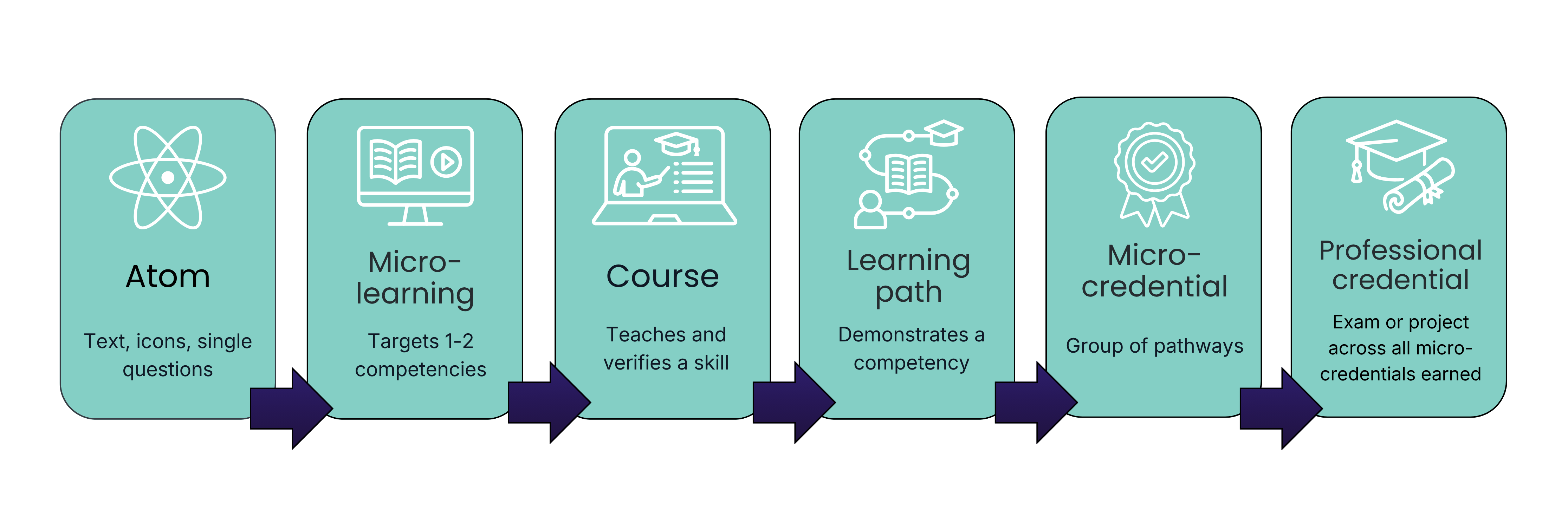
Atomic design is a well known principle that involves breaking content down into its smallest possible form. Applied to instructional design, this means using building blocks to create larger lessons, modules, courses, and finally full learning paths.
You can think of “atoms” as individual learning objects, which could be anything from text snippets and icons, to short assessment questions or individual interactives. Once created, these learning objects can be bundled into micro-learnings or micro-courses, which are only intended to target a single competency statement. These can be delivered fast in response to a pressing need.
Next, micro-courses can be combined to become longer courses — larger bundles of learning objects which teach and verify specific skills, knowledge or abilities, and then these courses are bundled in turn into learning pathways which demonstrate competencies. At a level above, learning pathways are grouped to become micro-credentials, and finally, the micro-credentials bundle up to a professional credential which offers a project or exam to demonstrate mastery of what’s already been learned in the micro-credentials.
Emily described the value of this approach for IMA during a recent webinar, Authoring at Scale: How IMA Built a Competency Framework That Moves at the Speed of Market Demand.
“What this approach lets us do is create things at the smaller scale and bundle them in different ways. We use pieces where needed and then we are able to create pathways that lead to goals rather than just a handful of thirty or forty courses. The learner can use those learning pathways to move from foundational to proficient to expert level learning by benefiting from that scaffolding.”
Use modular thinking to move fast
IMA uses atomic design principles to create as many as 50 courses per day during peak periods. When learners need something, they need it in the moment—and they won’t wait for you to spend two weeks building the right course. Responding in real-time to market demands is critical.
“By building in atomic units, we can ship sooner,” said Emily. “We can deliver a nano-course first immediately, then expand to a one- or two-unit course in two weeks, then maybe build that into a learning pathway within the month. By thinking modularly, we can ship fast, and that way our learners have what they need to start, and we can keep growing from there.”
Reuse content, but ensure visibility
24.4% of the customer education leaders we surveyed who use an LMS cited content structure as the biggest barrier to omnichannel delivery. It’s an easy trap to fall into: teams build the same foundational lesson three different times, once for the certification track, once for the partner portal, once for the customer-facing academy, because their LMS treats each destination as a separate container with no shared memory of what a learner has already done. Businesses end up duplicating authoring effort on the back end, and creating a fractured and repetitive experience for the learner, who asks in frustration, “haven’t I completed this microlearning already?”
On the Thought Industries platform, modular content structure can solve this problem. As learners complete stackable units, they are checked off as complete, no matter where the learner encounters them. If the content reappears elsewhere in a different course, pathway or certification, that existing competency is noted for the user and documented for the admin behind the scenes.
By structuring content as discrete, reusable units, you ensure your content delivery structure mirrors how modern learners show up; in and out of multiple programs, on different channels, at their own pace, and all without ever forgetting what they’ve learned.
Build from templates, not from scratch
Instead of designing from zero, starting from a template expedites the build process, and ensures that any pages, slide layouts or module banners use the same design language across all courses in your catalog.
This means learners know what to expect, and gives them ready familiarity with your material. These templates also allow the organization to handle variation without creating dozens of near-duplicate assets.
Structure content for AEO (Answer Engine Optimization)
If you’re nervous about your content being surfaced by LLMs, join the largest growing club out there right now. But there are already best practices to make sure you structure your learning content effectively to get the attention of your customer’s favorite chatbot:
- Start with a learning objective: Lead each lesson or course description with a plain-language definition of what the learner will be able to do, then layer supporting detail beneath question-shaped subheadings (“What will I learn in this module?”, “Who is this course for?”). AI systems extract answers from self-contained chunks, so treat every lesson summary, module overview, and course description as if it could be pulled out of context and shown as a standalone answer.
- Make content accessible: In the Thought Industries platform, you can choose to make the course detail page discoverable for AEO once the content is released, and public accessibility is controlled at the content level. For articles and videos that means enabling “Accessible to Public,” and for courses and micro-courses it means setting lessons to “Open to Everyone.” Pair your content architecture work with an audit of what’s set to public before you optimize the writing itself.
- Check your format: On the technical side, JSON-LD is the format to standardize on. It sits in a script tag separate from your page markup, which means your instructional design team can restructure lesson flow without breaking the schema, and vice versa. For course catalogs and public lesson pages, the highest-leverage schema types are Course (or LearningResource) for the overall offering, FAQPage for any “who is this for / what are the prerequisites / how long does it take” content, and Article/BlogPosting with a current dateModified for standalone lessons or articles.
- Make it match: Remember, your JSON-LD has to match your visible lesson content exactly, because AI systems tend to tokenize the whole page (script tag included) rather than parsing it as a separate structured layer. Any drift between what the schema claims and what the page says gets read as inconsistency.
It’s helpful to consider the principles of atomic design and the best practices of AEO when structuring your learning content. Both will help you build content as clear, self-contained units that can be repurposed in many ways, rather than long, single-use undifferentiated blocks of courses. Get that structure right once, and it pays off in faster authoring, better reuse, and content that’s ready to be found by learners and answer engines alike.
Interested in learning more about leveraging AI when structuring content? Download our AI-powered Customer Education Action Plan for a checklist to get you started.